Showing posts with label Kildalton. Show all posts

Monday, October 15, 2012

Tales and Travels of a School Inspector

The 1872 Education Act created a system of state-funded schools in Scotland overseen by local School Boards. Long before Ofsted, school inspectors were sent around the country to check that schools were doing their job properly and that therefore that they were entitled to continue to receive funding . John Wilson, who was born in Dufftown in Banffshire and had been a headteacher in Morayshire, joined the inspectorate in 1882 and continued as an inspector until the 1920s, with his patch covering parts of the Highlands and many of the Islands - including Islay, Jura, Colonsay, Lewis and Orkney, among others. Shortly after his retirement he wrote 'Tales and Travels of a School Inspector' looking back on his long career (republished by Acair in 1998).


His account provides lots of interesting details of the social history of that period. He describes the poverty, including a visit to Lewis where 'children were vomiting water' during an examination as a result of being desperately hungry and gorging on water to try and fill themselves up. He mentions religious controversies, including Free Church ministers in some areas attempting to ban the teaching of singing in schools. And he remarks sadly on the decline of Gaelic - a fact partly explained by the fact that most teaching was in English.

Some children lived too far away to attend school, and the inspector was also required to check that they were being taught properly at home. He describes an occasion on Jura where 'A girl twelve years of age, daughter of a gamekeeper, who lived fully twelve miles from the nearest school' was late to meet him for examination as a result of stormy weather. So as not to miss the boat back to Islay, the inspector put the girl through her maths and other tests in a farmer's cart on the way to the ferry

Travelling around the islands in all seasons was not without its risks and he describes a hair raising journey in a storm from Colonsay to Port Askaig, where on finally getting off his boat at 2:30 am he was harangued by a parent complaining about his child's school!

In a chapter on hospitality he mentiond 'staying for a few nights in Bridgend Hotel in Islay' one winter, where 'The wife of the proprietor of Dunlossit in the north end of the island was entertaining a number of the leading natives'.  Seeing that Wilson was all alone, the inspector was invited to join the party as a result of which he 'spent a most enjoyable evening'.

Also in relation to Islay he talks of the 'exquisite crosses at Kildalton in Islay' and says that  'I never visited the small school of Kintour in this neighbourhood without having another look at it and other crosses within two hundred yards of the public road'.

Wilson was in Islay during the First World War, and recalls one of its great tragedies: 'When I think of Islay I see Port Ellen, where I had occasion to be during the Great War when the Tuscania, with thousands of American soldiers, had just been torpedoed by a German submarine off the south coast with terrible consequences. Two rafts of curious construction lay stranded on the sandy beach in front of the hotel. A series of loops of rope with small globular wooden floats was attached to each side. A soldier clutching one of these could keep himself afloat till rescued/ The bodies washed ashore were collected and buried in a fenced piece of grassy sward about a mile to the west of the village' (this burial ground was at Kilnaughton - see previous post on Tuscania burials).


Portnahaven School in 1915 with teacher Jean Currie on left -
Wilson would almost certainly have visited this school during this period
(photo from Betsy West's Photo Gallery)


Friday, September 7, 2012

Kilchiaran Cup Stone

Outside the walls of the ruined chapel at Kilchiaran there is an intriguing stone lying in the ground. It is a fine example of what is known as a cup-marked stone, with a number of circular carvings on its surface. Examples of similar stone carvings are found elsewhere in Scotland, Ireland and northern England, and indeed further afield. Archaelogists find it difficult to even assess how old they are, but most agree they date back to the neolithic period (between 4000 and 6000 years ago).


photo by Neil Gordon-Orr, July 2012
According to RCAHMS: 'A cup marked and perforated slab lies in rough grass 20yds WSW of St Ciaron's Chapel (NR26SW 6) and 20yds N of the road. The slab is of schist 6ft by 3ft with a thickness of 6ins exposed, the rest being buried. Graham noted 22 cups in 1895 but only 18 are now visible, 6 1/2 ins in maximum diameter and 4 ins deep, clearly man-made but some having vertical sides. Two cups have penetrated the slab completely. The local tradition is that church-goers turned a pestel in any cup-mark and wished. The constant turning wore the cups, in some cases right through the stone'. There is a stone in one of the holes to this day, as shown in the picture I took this summer.

Robert C. Graham noted the stone in his 1895 work 'The Carved Stones of Islay': 'There are indications of various ancient buildings near the chapel, and to the west of it there is a curious cupped stone, of which a sketch is given. The holes vary in depth; two, which are shaded, pierce the whole thickness of the stone'. Graham included a sketch of the carvings, not all of which are still clearly visible:


Clearly the stone has been there for many centuries longer than the 14th century chapel, and indeed may have predated the birth of Christianity by a couple of thousand years. That suggests that the Kilchiaran site may have been regarded as special for a very long period of time.

What the carvings represent, if anything, we can probably never know. Were they a way of recording information about the stars or the seasons, or were they just a pattern people made because they liked doing it? 

The folklore suggests that people used stones and similar places for their own purposes long after the intentions of those who made them had vanished into the ancient past. In the case of Kilchiaran it is possible that the original carvings were made thousands of years ago but in more recent times they have been further worn by people turning stones in them and making wishes. 

The folklore was described in an article by Ronald W. B. Morris in the Proceedings of the Society of Antiquaries of Scotland, vol. 100 (1967-1968) in his article "The Cup-and-Ring marks and similar sculptures of Scotland: a survey of the Southern Counties Part II." He wrote that at Kilchiaran the 'Cups [were] said to have been enlarged by former 'wishing' rite', and also noted similar customs at Kilchoman: 'At foot of Celtic cross 20yds east of church in cemetery. On slate slab (3ft square 0.25 ft high, forming base of cross) 4 basins up to 7 inch diam. 6inch deep - still used in 'wishing ' or 'fertility' rite by turning a pestle 3 revolutions with the sun and leaving a coin. Full of pennies on 1968 visit'; and also at Kildalton: 'On the flagstone base of the Kildalton Cross 7yds. north of chapel. On flagstones NE corner was a cup mark, similar in size and traditional use to that at Kilchoman - broken off and stolen c.1920'.

Across Scotland and Ireland all kinds of folklore and legends have become attached to cup and ring stones, as Kevin L. Callahan shows in his survery  Ethnographic Analogy and the Folklore of Cup and Ring Rock Art (2000)

More photos of the  Kilchiaran stone at the Modern Antiquarian.

Sunday, August 12, 2012

Callumkill

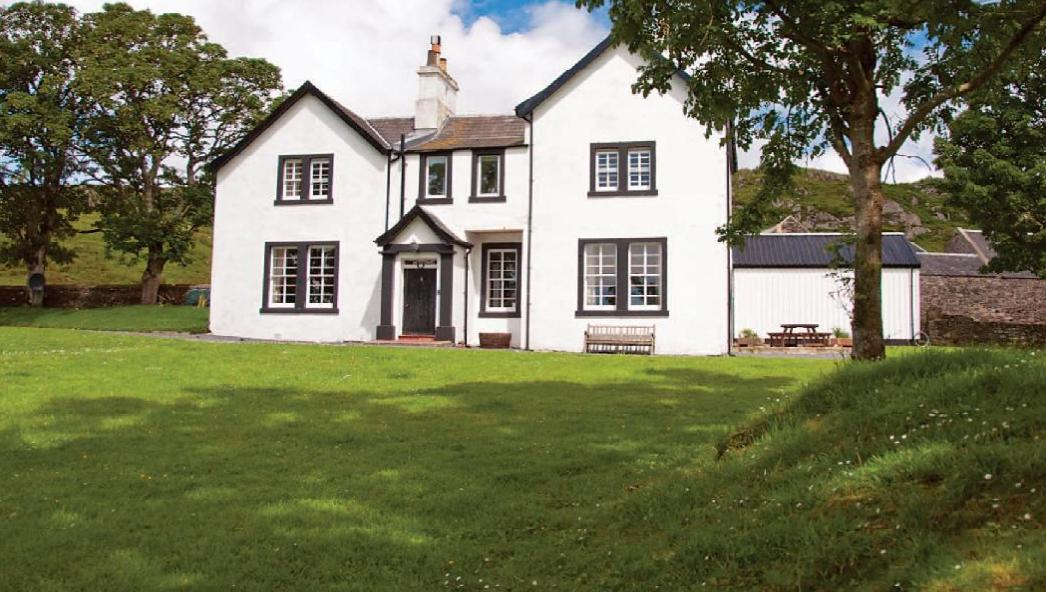
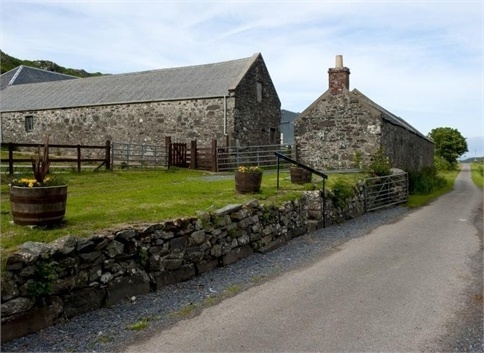
Callumkill estate, near Ardbeg, is up for sale. The starting price is £1,500,000, for  2100 acres, farmhouse, buildings and livestock. There's Victorian terraced houses for sale for not much less than that in parts of London, but sadly it's still a little out of my price range...

I would certainly buy it if I could, as my grandparents lived and worked on the farm for many years and I spent many summer holidays there in the 1960s and 1970s.


The estate agent's brochure (Savills) has a summary of the site's history: 

'Callumkill means Keill (chapel) of St Columba. St Columba was an Irish saint who left Ireland in AD 563 and settled in Iona. Abbots of Iona held supremacy over all the Columban monasteries in Ireland and Scotland. The chapel of Callumkill is gone now, but the main house is built on its ruin and uses some of the stones, an example of which is the sandstone around the kitchen fireplace. There is no formal record, but the house is believed to have been completed before 1851.

The earliest record of Callumkill is in a Crown Charter dated 23rd February 1760, granting Daniel Campbell of Shawfield the lands and Barony of Islay. In November 1855, James Morrison of Basildon Park, Berkshire, and Islay, sold Kildalton (including Callumkill) to John Ramsey. The Ramseys sold Callumkill to Henry Allan, the manager of Lagavulin distillery, in 1924. Dr John Cecil Macgown purchased Callumkill in 1952 when he and his wife Marjorie responded to a small advertisement in The Times for a Scottish sporting estate. They visited Islay, walked up to the top of Callumkill’s first ridge, took one look at the view over the fields, ridges and hills and out to the sea beyond, and knew they had found a very special place. They both lived out the rest of their lives there; at 110 years old, Marjorie lived to be the oldest woman in Scotland. The estate passed to her grandson, the current owner, in 2008'.


Given the farm's name, it seems clear that there was a church dedicated to St Columba in the area, although an RCAHMS note from 1978 states 'There is a strong local tradition of a chapel at Callumkill, but the owner, Dr McGowan, has no knowledge of its likely site'. Nevertheless it certainly possible that  it was on or near the site of the house or nearby farm buildings, and that old stone was recycled in the building.. 

I also recall that there was (and presumably still is) some kind of partially underground chamber in the lawn of the main house, though whether that was a storage place linked to the building of the house in the mid-19th century or an earlier structure I am not sure - could it be that mound in the front right of the picture (anybody know?)


My grandparents Neil Orr (my namesake, 1906-1980) and Janet Orr (born Janet MacTaggart, 1906-1990 ) lived at Callumkill in a corrugated-iron clad wooden building which I think was demolished after they moved to Port Ellen on retirement in the late 1970s. I went by there a couple of weeks ago and could see no trace of it - it was near to where a fairly new cattle shed now stands, in between what is now described in the brochure as the 'shepherd's cottage' (where Robert Shaw and family lived at that time) and the older farm buildings.   

That's me with my granny outside the house, some point in the 1960s:


And that's Neil Orr senior and junior at Callumkill in the same period:


Photos of Callumkill from Savills brochure, except for the two family photos above.